Planning for the conversation (LO2)
Let’s start to bring the concepts together with a case study and make a plan to have a difficult conversation.
 Learning activity: Getting to know ourselves better
What are your initial thoughts on the presented scenario?
Case #1
A roommate (parent, friend, partner, etc.) turns down the temperature on the hot water tank. Now no one in the house can take a hot shower.

Go to your Workbook and write your answers, and then click on the checkbox.
Thanks! There are lots of initial ways you might think about the conversation. Maybe you are picturing that your friend is being rude and inconsiderate. Maybe you are worried because your family has been struggling financially and maybe there is not money to pay the water bill. Maybe you think your partner is being selfish.
Regardless of what your initial thoughts were, the point is that we all quickly form initial thoughts and reactions to situations. We have to be really careful though, because these thoughts are often assumptions that can be wildly incorrect. They can also hinder our ability to find the real source of an issue.
Before you have a difficult conversation, write down your Shoddy First Draft (SFD).

- Capturing our SFD means putting those initial thoughts on paper, so that we can better examine the story we are telling ourselves.
- A SFD includes all of our fears, insecurities, and worst-case scenarios.
- We often discover that we have filled in the story with false information—suppositions, confabulations, and conspiracy theories.
- Becoming curious helps us figure out which parts of our story are true. This step often involves fact-checking with other people.
Learning activity: Planning template
For the next few activities, consider a situation that you want to work on. You could use the one we just worked on or one of your own; start small if you are using a situation of your own. Download the Planning Template and fill out the first section with your SFD.
Go to the Planning Template and write your answers, and then click on the checkbox.
Now that you have identified your SFD, there are a number of things you can do to prepare for the conversation. Before the conversation, identify the following and write your answers down in your planning template.
Questions to ask yourself before the conversation:
- What do you want to accomplish at this meeting? A change in behavior? A commitment? An apology? Write down what is important to you before the meeting starts.
- Make an honest effort to consider the other person’s perspective. Write down:
- What you think they want. Can you give that to them? If not, why? Can you offer alternatives?
- Accept the fact that you can only know for sure what your intent and your motives are. You can’t know what someone else is thinking; you can only speculate about that.
- Conflicts don’t happen in a vacuum. Are there any external factors contributing to the tension? Do they need to be addressed now?
- Re-examine your personal and professional behavior in the situation up to this point – especially your email messages. Can you honestly say you’re proud of everything you’ve written, said, or done to the person you’re about to meet with? Would you have done anything differently? Is any apology warranted on your part
- Consider your interests and the other person’s (see more below).
- What will you need to have the conversation successfully? That could include having the conversation in private/public space, letting the person know that you don’t tend to make eye contact but you’ll be listening (e.g., people with autism), eating in advance.
Interests
There are different types of interests and a combination may be involved for any conversation. Take a look at each type, and explore the ways we can expand, uncover, and incorporate those interests in conversations.
Substantive:
- Material Concerns – Money, Resources, Time
Procedural:
- How things are done
- How decisions are made
- How disputes are resolved
Psychological:
- Emotional needs, respect, trust, fairness, acknowledgement
- More issues and interests = more room for tradeoffs & broadening the range of possible solutions
- Identifies stakeholders
- More issues and interests addressed the more durable
- Less possibility for future misunderstandings
- Topics that need to be discussed
- Problems that need to be resolved
- Creating agendas
- Breaking issues into sub-issues
- Prioritizing interests
- Be clear on your own interests
- Understand the other person’s interests
- Prioritize interests
- Use interests to reframe positions into problems that can be worked on
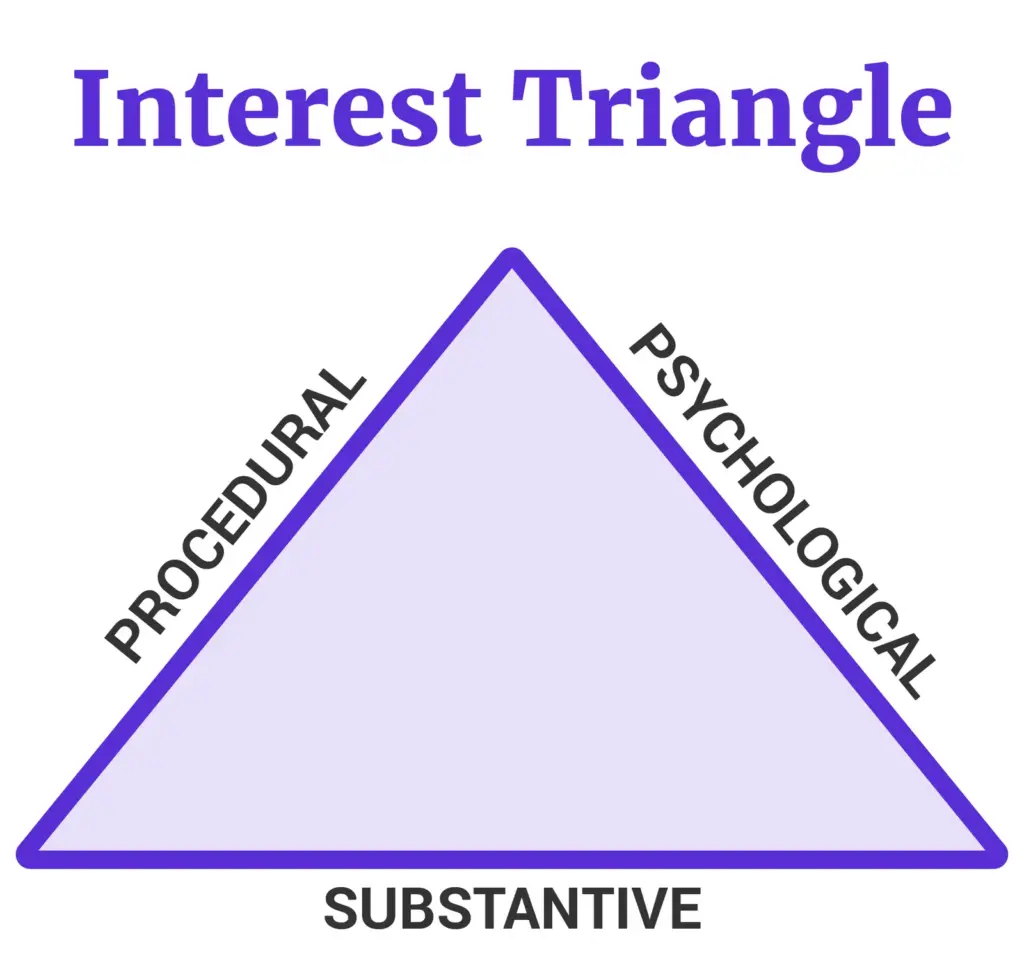
Conversations are a constant “give and take”. We are looking for a solution that meets X for you and Y for me. Understanding the interests of both parties is an essential part of reaching a resolution that works for both sides. When planning for a conversation make sure you have a clear idea of everyone’s interests, and take these into account in your plan.
It’s always okay to write down your plan before any conversation. That plan will evolve and change depending on the situation you’re working through.