Part 2: Project planning
Project planning
What skills and tools are required to start planning a project? Includes and overview of goal-setting and creating a work breakdown.
In the first phase of a project, the “Initiation and Planning” phase, we began with creating a plan for the project. This step is one of the most important aspects of project management. In this section of the module, you will learn skills and tools to aid your planning process as well as the key components of any project.
A key component we have already alluded to and discussed in the introduction to this module are setting the goals of the project.
Goals
Every project has a goal. A well-defined goal helps set what work needs to be done and when. As a refresher from the introduction:
SMART is an acronym that is used to set better goals. SMART stands for:
S
Specific
M
Measurable
A
Accountable
R
Realistic
T
Time-Defined
Instructions: Click on the letters to see each description.
Specific: Your goal should be as simple, precise, and defined as possible. Think what, why, when, and how.
Measurable: Describe the tangible evidence that you have achieved your goal. What will you see, hear, be able to do (ideally outwardly visible or demonstratable). Establish criteria to measure your progress.
Accountable: What is the mechanism to keep you accountable for your goals? Individually, this could be another person or yourself. In a group, project goals must be agreed upon and understood by all stakeholders.
Realistic: Goals of a project should be a challenge but they should also be achievable. You must possess the appropriate skills and abilities to achieve the goals, and you must have access to the required resources.
Time-defined: Goals should have unambiguous timing associated with them, which should also be realistic.
Example:
- Vague goal: Contact potential supervisors for PhD applications.
- SMART goal: Secure interviews with at least three potential PhD supervisors I’m interested in working with by December 10th.
A good project NEEDS a good goal, a SMART goal!
 Learning activity 3: Setting a SMART goal for a project
For this activity, practice setting a SMART goal. In the corresponding discussion forum, write down a “bad” goal and convert it into a SMART goal for a project that you are currently working on or plan to work on in the near future. The goal could come from the project you used for the worksheet in the “Proactive project management worksheet” activity. In addition, read through the goals of at least two other people, see how they converted them into SMART goals, and give a suggestion of your own for turning their goal into a SMART goal.
NOTE
You will use this goal and project throughout this module to build a complete project plan so think carefully and choose a goal that’s relevant to you!
Go to Discord and write your answer. You can also keep a copy in your Workbook.
Project deliverables, work breakdown, and scope
The goal helps define what will be produced by the project, the “final product”. A project’s goal likely consists of multiple, smaller components or steps called deliverables. Deliverables are the smaller things that will be produced in the project and help define all the work that needs to be done.
Each deliverable should be SMART-like in nature.
Details on the quality/quantity of the deliverables and their approximate (goal) deadlines help provide context and accountability.
- Example: If the goal is to complete your PhD by 2026, the deliverables to successfully achieve this goal might include completing your thesis, your course work, and a departmental seminar. You may also have goals around professional development, including networking and presentation skills.
A work breakdown structure can be used to break down goals into their deliverables and work packages.
Notes for the work breakdown structure:
- Tasks may not need to be properly sequenced (by importance or time). Sequencing can be done later when schedules are developed.
- Tasks headings must be clear and concise, providing information that allows differentiation of the different tasks that need to be complete without extraneous details such as how the task will need to be completed.
- Be reasonable with subdivisions of individual tasks; they depend on the deliverable/work structure at hand and they don’t need to be overly specific. For example, you may not need to subdivide writing an abstract and writing keywords.
Here is an example of a work breakdown structure that could be created for the overall goal of writing a thesis:
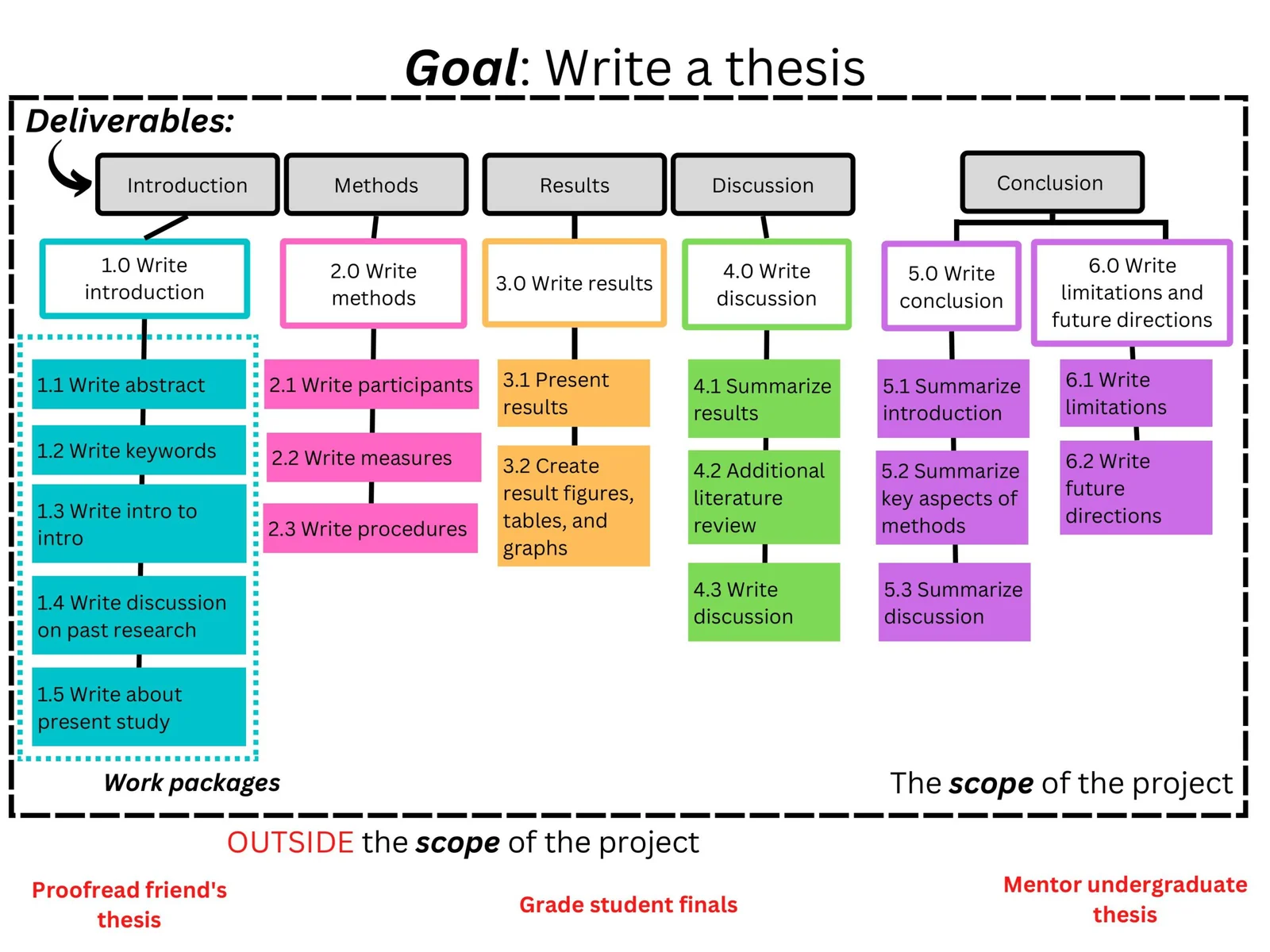
Title: Goal: Write a thesis
Deliverables:
- Introduction
- Methods
- Results
- Discussion
- Conclusion:
1.0 Write introduction (Teal box)
- 1.1 Write abstract (Teal)
- 1.2 Write keywords (Teal)
- 1.3 Write intro to intro (Teal)
- 1.4 Write discussion on past research (Teal)
- 1.5 Write about present study (Teal)
2.0 Write methods (Pink box)
- 2.1 Write participants (Pink)
- 2.2 Write measures (Pink)
- 2.3 Write procedures (Pink)
3.0 Write results (Orange box)
- 3.1 Present results (Orange)
- 3.2 Create result figures, tables, and graphs (Orange)
4.0 Write discussion (Green box)
- 4.1 Summarize results (Green)
- 4.2 Additional literature review (Green)
- 4.3 Write discussion (Green)
5.0 Write conclusion (Purple box)
- 5.1 Summarize introduction (Purple)
- 5.2 Summarize key aspects of methods (Purple)
- 5.3 Summarize discussion (Purple)
6.0 Write limitations and future directions (Purple box)
- 6.1 Write limitations (Purple)
- 6.2 Write future directions (Purple)
At the bottom of the image, still inside the dashed lines, on the left “Work packages”, and on the right “The scope of the project.”
Outside Scope Tasks (Red text at the bottom):
- Proofread friend’s thesis (below Introduction section)
- Grade student finals (below Results section)
- Mentor undergraduate thesis (below Conclusion section)
Source: Images by storyset & macrovector on Freepik
Share your thoughts in Discord and write your answer.
One cause of failure that we noticed in that video was a breakdown in communication. Based on the images shown in the video, the customer appears to have asked for a tree swing with a wooden seat hung to a strong branch of the tree with rope. The project leader then takes this information, brings it to various members of the team to plan, execute, and carry out the project’s tasks.
However, along the way details of the project become lost, or are interpreted differently by different people. The lack of detail, documentation, and clear communication avenues dramatically change what the customer receives at the end of the project and ultimately leads to a failed project outcome. There are many other common causes of failure, some of which you or your peers may have mentioned. The main takeaway from this activity is to be able to start identifying some potential causes of failure and recognizing that these challenges and problems can be very common.
Throughout this module, you will learn and improve project management tools and skills to identify potential causes of failure, address them, and subsequently increase our chances of the project’s success. Furthermore, you will learn many skills and techniques to prevent the common causes of failure from occurring at all.
Learning activity 4: Create a work breakdown structure
In this activity, we will practice making a work breakdown structure and project scope planning. You can complete this activity in your Workbook.
First, create a work breakdown structure for the goal of the project you created in the “Setting a SMART goal for a project” activity by:
- Listing your main SMART goal (from the “setting a SMART goal for a project” activity)
- Listing your deliverables for this goal
- Listing individual tasks that form work packages for your deliverables and who will work on them (if applicable)
- Listing out-of-scope activities that may come up
NOTE
Identifying potential out-of-scope activities can be challenging. Try communicating with colleagues/friends who may have completed similar tasks!
After creating your work breakdown structure, determine the resources required for the project and whether you have them. In addition, think of what you can do to acquire missing resources, replace them, or operate without them – we will discuss resources more in the next part.

Go to your Workbook and write your answers.
Documentation
So far we have discussed many aspects of planning for your project and by now you’ve engaged in several activities where you have written down aspects of your project’s plan.
Planning for your project is incredibly important; documenting your plans is even more important. Documentation can take many forms but ultimately, your documentation needs to be clear and transferable. What you write must be understandable for you and your stakeholders. Furthermore, your documentation should be transferable to future teams who may work on a similar project, so that they can understand and build from it. These future teams could even include yourself!
An example of a template for a project plan document is the project charter, a document that clearly defines and communicates key aspects of the project. The project charter provides broad information on the project goals, as well as detailed technical information on individual aspects. It sets a baseline for the project and starts, and keeps everyone involved in the project on the same page.
The project charter considers:
- Project goals
- Project deliverables
- Work breakdown structure/activity list
- Project scope (both in and OUT of scope items)
- Resources required
- Project schedule
- Constraints
- Assumptions
- Risks
This outline is one method and example for organizing the project plan, but you may want to adapt the format of the plan to best suit your needs or the project’s needs.